
Civil Resistance and Institutional Resilience in Wartime Crisis Response: Insights from Ukraine Since the Russian Full-Scale Invasion
Recording
To start the video, click on the preview above this line
EuroISME
in association with
King’s Centre for Military Ethics (KCME) &
School of Security Studies, King’s College London
12 February 2026
At 16:00 GMT//17:00h CET//18:00h Ukraine time (90 minutes)
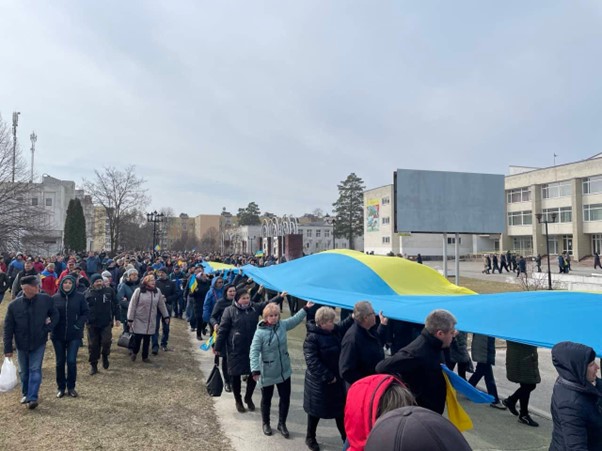
Join us for this exceedingly timely webinar with three outstanding Ukrainian scholars and practitioners who have been immersed and instrumental in mobilising the resistance and building the resilience of Ukrainian society in the face of Russia’s full-scale aggression. We will explore the rapid mobilisation of local communities to manage war-related crises since 2022, focusing on how pre-war decentralisation reforms and the evolving social contract since 2014 have strengthened local governance, adaptive capacity, and collective problem-solving under extreme pressure. In the course of this we will analyse strategies and impact of civil resistance throughout the conflict, demonstrating how nonviolent action contributes to social empowerment, political agency, and democratic transformation—despite the violence and disruption of wartime. Together, these perspectives reveal how community-driven innovations and civil resistance practices are redefining Ukraine’s democratic trajectory in the midst of war.
Chair: Dr Andrea Ellner, Senior Lecturer in Civil-Military Relations & Ethics, Defence Studies Department, King's College London, Deputy Director KCME, and co-Executive director EuroISME
Speaker: Vladyslav Skalskyy, Deputy Mayor of Vinnytsia city
Title: Municipal Crisis Response and IDP Integration: Vinnytsia City Territorial Community after the 2022 Full-Scale Invasion
Biography: Vladyslav Skalskyy, is Deputy Mayor of Vinnytsia city and a public administration expert with over 20 years of experience in business, economic development, strategic planning, and investment policy. He served as Head of Vinnytsia Regional State Administration in 2019–2020 and previously as Deputy Mayor responsible for the economic portfolio in 2016-2019. He is also a member of Vinnytsia Regional Council and chairs the Committee on Strategic Development and Investment
Speaker: Ms Oleksandra Romantsova, Executive director of Center for Civil Liberties (CCL). Organisation awarded with 2022 Peace Nobel Prize together with Memorial and Vesna organisations.
Title: Civil Resistance in Ukraine under Russian Aggression: Justice, Rights, and Democratic Resilience
Abstract: Oleksandra Romantsova will explore how Ukrainian civil society has mobilized civil resistance to defend human rights, pursue justice, and sustain democratic life during Russia’s hybrid warfare. It explains the roots and logic of this resistance, grounded in long-standing civic networks and post-Maidan reforms. The talk highlights the role of human rights documentation, legal action, and international advocacy in strengthening resilience. Finally, it reflects on ongoing national political efforts to sustain resistance and democratization.
Biography: Oleksandra Romantsova studied at the University of Economics and Law KROK in
Kyiv, where she obtained a Master's degree in International Economics from the Faculty of International Relations, receiving a second Master's degree in Project Management after a couple of years. At the end of 2021, she obtained a master's degree in conflict management and mediation. Since May 2014, she has pursued her professional career as a human rights defender at the Center for Civil Liberties (CCL). Oleksandra's first project involved monitoring and documenting human rights violations and political persecution in Russian-occupied Crimea. From May 2014 until the end of 2016, Oleksandra coordinated mobile observation of human rights violations and war crimes in eastern Ukraine and has continued monitoring political persecution in occupied Crimea. Since September 2017, Oleksandra has served as
Executive Director of the “Center for Civil Liberties”, and from February 24, 2022, she has also worked to coordinate the documentation of war crimes and advocacy as part of the global initiative "Tribunal for Putin". Oleksandra participates in field missions in the Kyiv region.
Speaker: Capt. Taras Prokop, Acting Head of the Civil-Military Cooperation Department of the Military Unit Military (A7035) and Local Governance & Civil Society Expert
Title: Civil–Military Cooperation and Civil Resistance in Ukraine: Functions, Impacts, and Stakeholder Coordination
Abstract: Taras Prokop will examine the role of Civil–Military Cooperation (CIMIC) in supporting civil resistance and societal resilience in Ukraine during Russia’s full-scale aggression. It explains the core functions of CIMIC, including coordination with local authorities, support to civilian populations, and facilitation of humanitarian and stabilization efforts. The talk highlights how CIMIC structures interact with civil society actors, volunteers, and communities under conditions of hybrid and conventional warfare. It also explores the societal impacts of these relationships, from trust-building to protection of civilian space. Finally, the session reflects on how CIMIC can strengthen democratic resilience while navigating complex political and security constraints.
Biography: Taras Prokop, PhD in History at Yuriy Fedkovych Chernivtsi National University elected member of the Chernivtsi City Council, and currently Acting Head of the Civil-Military Cooperation Unit for military unit A7035 where he fosters effective collaboration between the military and the civilian sector. Strongly committed to building resilient, transparent, and inclusive institutions in both the public and defense sector, he previously served as a Company Commander in the same unit. He is a specialist in decentralization and civil society development with over a decade of experience in local self-government reform, including Adviser to the Mayor of Chernivtsi and a Regional Specialist for the U-LEAD with Europe Programme. In these roles he focused on strategic planning, the modernization of administrative services (ASCs), and enhancing public participation in decision-making. A significant portion of my career has been dedicated to leadership roles within Civil Network OPORA, where he has:
- Coordinated election monitoring across multiple cycles to ensure the integrity of the electoral process.
- Led accountability campaigns, specifically measuring the Publicity Index of the Chernivtsi City Council to advocate for transparency.
- Managed educational programmes and parliamentary monitoring to bridge the gap between citizens, educational institutions, and elected officials.
Speaker: Dr Oleksandra Keudel
Title: Societal Resilience and Local Governance in Ukraine amid the Russian Full-scale Invasion
Abstract: Oleksandra Keudel will examine how Ukrainian local communities have rapidly mobilised resources, expertise, and institutional innovations to manage war-related crises since 2022. She will also discuss how pre-war decentralisation reforms and Ukraine’s evolving social contract since 2014 have shaped these community-level responses and enabled societal resilience under extreme pressure.
Biography: Dr. Oleksandra Keudel is Associate Professor and founding Director of the Center for Democratic Resilience at the Kyiv School of Economics, and Vice-Chair for Science in the Social Sciences Department, Kyiv School of Economics. She is also a fellow at the Center for East European and International Studies (Berlin) and the Center for Governance and Markets (University of Pittsburgh), and an Associate at the Harvard Ukrainian Research Institute.
Recent publications
Keudel, O., & Huss, O. (2025). Polycentric crisis response and societal resilience: How local communities address internal displacement in Ukraine due to the Russian full-scale invasion. Post-Soviet Affairs, 1–23.
Keudel, O., Hatsko, V., Darkovich, A., & Huss, O. (2024). Local Democracy and Resilience in Ukraine: Learning from Communities’ Crisis Response in War (Research Report No. 33). Swedish International Centre for Local Democracy.
Keudel, O., & Huss, O. (2023). Polycentric governance in practice: The case of Ukraine’s decentralised crisis response during the Russo-Ukrainian war. Journal of Public Finance and Public Choice, 1(aop), 1–26.