
Winning thesis
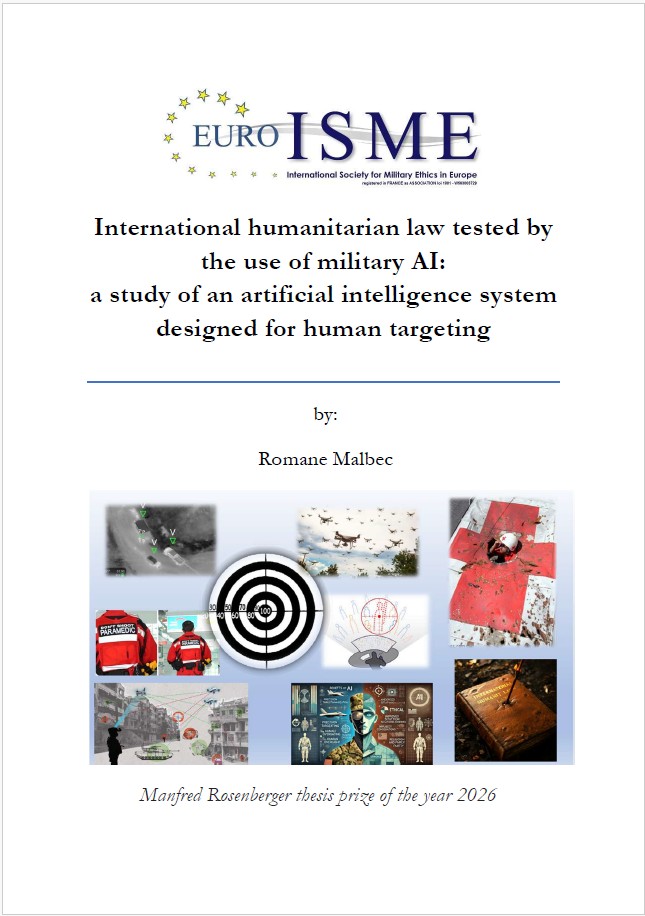
EuroISME congratulates Ms. Romane Malbec of the Catholic University of Paris (France) on winning the first prize in the annual contest for the Manfred Rosenberger prize for the best European students’ thesis (MA) written on the topic of military ethics. The title of her thesis is “International humanitarian law tested by the use of military AI: a study of an artificial intelligence system designed for human targeting.” The prize was awarded to her at EuroISME’s conference in Amsterdam on May 11.
The thesis of Ms. Malbec examines the challenges posed by the rise of artificial intelligence (AI) to international humanitarian law (IHL), with a particular focus on AI systems applied to human targeting. Adopting an approach that combines legal, technical, and ethical perspectives, it analyzes the compatibility of autonomous lethal weapons systems and human-supervised decision-support tools with the fundamental principles of IHL, such as distinction, proportionality, and precaution.
The study highlights how these technologies, capable of assisting or even replacing human intervention, call into question the very foundations of the law of armed conflict, which was historically designed to be implemented by human actors. It underscores the difficulties of integrating such systems into the existing legal framework, due to their technical limitations—algorithmic opacity, uncertain reliability, and embedded biases—as well as the legal challenges and geopolitical tensions they generate.
In this context, the thesis questions the ability of IHL to effectively regulate these new technologies in operational settings. It emphasizes the need to preserve meaningful human control and examines issues of accountability in the event of system failure. In light of divergences between States and the lack of international consensus, it highlights the urgency of adapting the current legal framework.
This work thus offers an in-depth reflection on the future of IHL in the age of artificial intelligence, at the intersection of legal requirements, operational constraints, and ethical considerations.

In her laudation on behalf of the jury, Dr. Asta Maskaliūnaitė points out that the winning thesis of Ms. Malbec
“… tackles one of the most urgent and unresolved questions in contemporary military ethics: can International Humanitarian Law, a body of norms built around human moral judgment, genuinely govern AI systems designed to select and kill human beings? The thesis refuses the comfort of an easy answer. It does not declare the law obsolete, nor does it wave away the limits of the law. Instead, it undertakes a rigorous, two-part legal and ethical dissection of exactly where the existing framework holds, where it bends, and where it risks breaking entirely. Romane Malbec handles these problems with the precision and intellectual courage, not shying away from concrete real world examples. Her case study of the Israeli AI targeting system Lavender, used in the war in Gaza, and already notorious for the operators spending barely twenty seconds reviewing each target is one such legal test case. Under her analysis, such a system, even nominally ‘human-in-the-loop,’ produces a troubling erosion of meaningful human control.”
Dr. Maskaliūnaitė added that the Manfred Rosenberg Prize “honours scholarship that does not merely observe the crisis at the intersection of warfare and ethics, but does the painstaking work of trying to resolve it. Romane Malbec has done exactly that.”
The original French version of the thesis is already available on our website (here). And the English translation can be found (here). In an afterword, the author responds to Pope Leo XIV's encyclical Magnifica Humanitas, published on May 15, 2026, a few days after the prize was awarded.
New name of the prize
During the prize ceremony, it was also announced that EuroISME’s Board of Directors has decided to change the name of the students’ prize in order to commemorate the passing of one of its founders, Col. (ret.) Manfred Rosenberger. In order to mark the occasion, Manfred’s son Malte Rosenberger took part in the prize ceremony. In the future the prize will be known as the Manfred Rosenberger prize for military ethics.